 The




Latest Guides

Job opportunities in the USA span every industry and skill level, with pay and perks that vary widely by role and employer.
The US labor market runs from warehouse shifts and retail floors to nursing, the trades, software and customer support, and entry requirements range from none at all to state licensure. Pay is set by the employer, the state, the industry and your experience rather than by any national standard, so the only reliable number is the one in a current posting.
8 min read
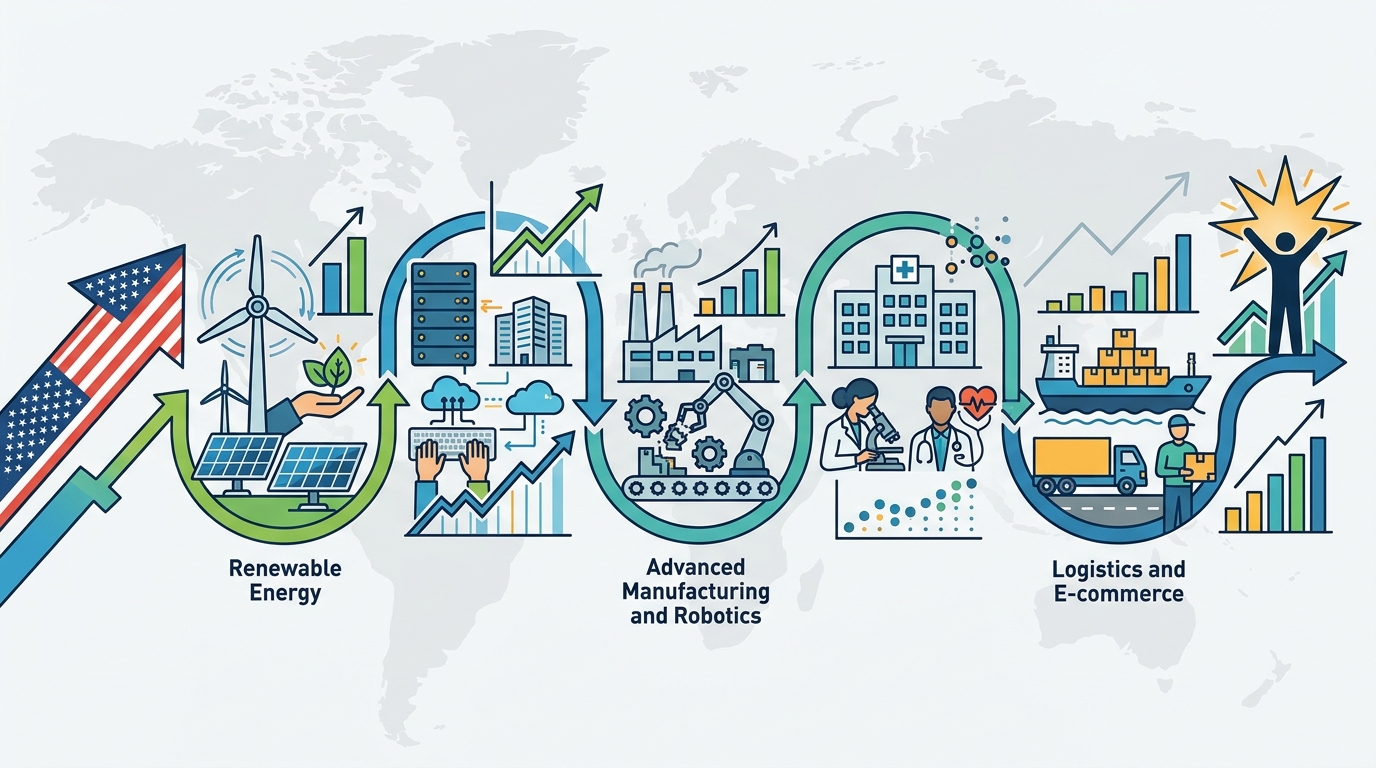
Employment opportunities in the USA are open across growing industries in 2027 — find the right fit for your skills and experience.
Hiring in the United States in 2027 is uneven: some industries post openings month after month, while others slow down. Healthcare and care support, logistics and warehousing, skilled trades, customer and back-office operations, and data and software roles tend to be the most consistent, and many of them accept people switching in from other work.
8 min read
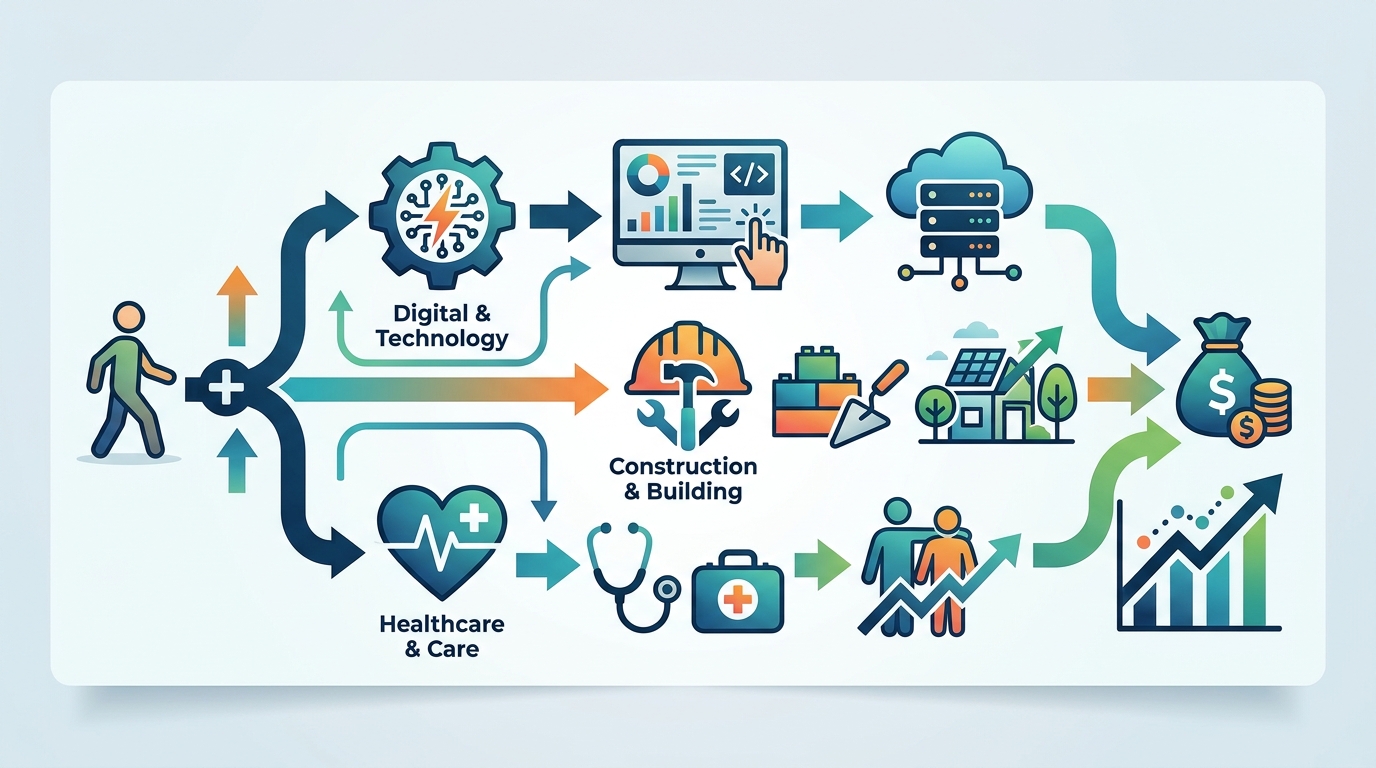
¡Alerta laboral 2027! Descubre empleos bien pagados y de alta demanda que no requieren experiencia previa.
Hay ocupaciones en US que crecen rápido y aceptan principiantes, porque la formación ocurre en el puesto, en un aprendizaje pagado o en un curso corto. La Oficina de Estadísticas Laborales de US publica una tabla con las 20 ocupaciones de mayor crecimiento proyectado entre 2025 y 2035, con el salario mediano de 2025 de cada una (U.S. Bureau of Labor Statistics (BLS), Occupational Outlook Handbook, 2026-08-27).
7 min read

2027 Job Market Alert! High-Demand Careers Worth Exploring Now
The jobs US employers are expected to keep hiring for cluster in three areas: healthcare, computing and data, and clean energy installation and maintenance. The U.S. Bureau of Labor Statistics projects the economy to add 6.7 million jobs from 2023 to 2033 (U.S. Bureau of Labor Statistics, 2024-08-29), with healthcare and computing occupations leading the growth.
9 min read
Las oportunidades de empleo en Estados Unidos te están esperando en 2026
En Estados Unidos se abren vacantes todos los años, y la mayoría no viene de empleos nuevos sino del reemplazo de quienes dejan su puesto de forma permanente (Oficina de Estadísticas Laborales de EE. UU., septiembre de 2025). El movimiento se concentra en sectores concretos: salud y cuidado en el hogar, oficios especializados, transporte y logística, y servicios comunitarios.
7 min read
Explorez des métiers bien payés disponibles dès aujourd’hui
Les métiers « bien payés » accessibles rapidement ne forment pas un seul emploi, mais un ensemble de familles de postes — santé et soins de support, logistique et transport, métiers techniques et du bâtiment, centres de contact et support client, informatique et données — où les employeurs recrutent de façon continue et où la rémunération dépasse souvent les postes d'entrée classiques. Ce guide explique ce que ces postes impliquent réellement au quotidien, qui recrute, comment la paie est structurée et quelles vérifications faire avant de signer.
9 min read
Explorez des métiers bien rémunérés adaptés à vous
Ce guide explique comment chercher un emploi bien rémunéré aux États-Unis sans vous limiter à un seul métier : à quoi ressemblent ces postes au quotidien, quels types d'employeurs recrutent, et comment la rémunération est généralement construite. Il vous indique aussi où vérifier vous-même les niveaux de salaire actuels plutôt que de vous fier à un chiffre lu quelque part.
9 min read

Career Change at 25: How to Start Without Losing Progress
Changing careers at 25 works best when you treat it as a transfer rather than a reset: you keep the working habits, references and credibility you already have, and you add the specific skills the new field asks for. Most people doing this part-time take six to twelve months to land the first role in the new field, longer if the target requires a licence or a formal qualification.
Priya Nathwani · 16 min read
Skill Development
See all →Career Change at 25: How to Start Without Losing Progress
Changing careers at 25 works best when you treat it as a transfer rather than a reset: you keep the working habits, references and credibility you already have, and you add the specific skills the new field asks for. Most people doing this part-time take six to twelve months to land the first role in the new field, longer if the target requires a licence or a formal qualification.
Priya Nathwani · 16 min read

How to Ask for Tuition Reimbursement: Steps (With Scripts)
To ask for tuition reimbursement, first find out whether your employer already has a written educational assistance plan and what its terms are, then make a short, specific case to your manager that ties the course to work you do or will do, and get the approval in writing before you enrol. Most of the work happens before the conversation: reading the plan rules, pricing the course and lining up the deadline with your employer's budget cycle.
Olu Adeyemi · 14 min read

How Long Does It Take to Become a Welder?
Most people reach their first paid welding job in six to twelve months. A short certificate program at a community college or trade school usually runs four to nine months, an associate degree runs about two years, and some production shops will hire with only a few weeks of training and put you on one joint until you are fast at it.
Theo Lindqvist · 13 min read

How to Switch From Hospitality to Healthcare
Moving from hospitality into healthcare usually means keeping the human skills you already have and adding one credential — a state-approved nurse aide course, a phlebotomy or medical assistant program, a pharmacy technician registration — that lets an employer legally put you in front of patients. For most people the practical route is a short certificate program of a few weeks to a year, often taken while still working shifts, rather than a degree from scratch.
Junie Castellane · 15 min read
Jobs News & Market Trends
See all →
How to Keep Your Job Search Moving During a Government Shutdown
A shutdown stops a lot of federal hiring, but it does not stop the rest of the labor market. The useful moves are narrow and concrete: confirm whether you are furloughed or excepted, file for unemployment in the right state if you qualify, convert your federal resume into something a private employer can read, and keep talking to people who are still hiring.
James O'Connor · 14 min read

Best Careers for Workers Affected by Federal Layoffs
If a federal layoff, RIF or deferred-resignation offer has ended your job, the strongest next moves are the ones that reuse what you already did: contract and grants administration, compliance and risk, program and project management, budget and data analysis, and safety or quality inspection. Those skills move into state and local government, universities, hospitals, nonprofits, federal contractors and regulated private employers without starting from zero.
Marisol Andrade · 13 min read

10 Signs a Company Is Hiring on Skills, Not Degrees
A company that hires on skills leaves evidence you can see before you apply: how the posting describes requirements, what the application form asks for, whether there is a work sample, and who sits in the interview room. This guide ranks ten of those signs by how reliably they predict a real skills-based process, explains how to check each one in minutes, and shows how to use what you find in your application.
Nadia Hassan · 13 min read

How to Switch From a Declining Industry to a Growing One
Switching from a declining industry to a growing one works best when you treat it as three separate problems: picking a target role that actually hires people like you, closing the smallest possible skills gap, and surviving the pay dip in between. Most people who do it well move sideways into an adjacent occupation rather than starting from zero, and the move takes somewhere between six and eighteen months from first research call to first paycheck in the new field.
Theo Lindqvist · 14 min read
Industry-Specific Guidance
See all →
10 Entry-Level Jobs in Real Estate Without a License
You can get paid work in real estate without a salesperson license, because large parts of the industry — leasing, property management support, transaction coordination, title, mortgage operations, marketing and research — are administrative or operational rather than brokerage. The roles below are ranked by how quickly an employer will hire someone with no industry history, and by how much the work teaches you if you later want a license, a management track or a commercial seat.
Marisol Andrade · 13 min read

12 Jobs for People Who Like Helping Others Without Being a Nurse
If you want work where you spend the day with people who need something from you, nursing is one route out of many. The roles below sit in clinics, schools, ambulances, shelters, pharmacies and people's homes, and most are entered through a certificate, an associate degree or employer-paid training rather than a nursing program.
Wei Chen · 12 min read

How to Become a CDL Truck Driver (Steps, Skills and Pay)
To become a CDL truck driver you need a commercial learner's permit, federally required entry-level driver training from a provider on the FMCSA Training Provider Registry, a DOT medical card, and a passing score on the CDL knowledge and skills tests at your state licensing agency. Most people go from first permit test to licensed and hired within two to six months.
Daniel Ortiz · 13 min read

How to Switch From Nursing to a Non-Clinical Career
Most nurses who move into non-clinical work do it by adding one credential or one project to the experience they already have, then applying to roles that still need clinical judgment — documentation, informatics, quality, research, utilization review. The transition usually takes six to eighteen months of part-time preparation while you keep working, and it often starts with a committee seat or a super-user role inside your current employer rather than with a new degree.
Sofia Bauer · 15 min read
Job Search & Platforms
See all →
How to Set Up Job Alerts That Actually Match What You Want: 5 Steps
Job alerts match what you want when you give each one a narrow brief — a small set of title variants, one location or work mode, one goal — and then maintain them. The setup takes about an hour across the big platforms; the maintenance is a 15-minute review every couple of weeks.
Priya Nathwani · 13 min read

How to Apply on a Company's Website Instead of a Job Board: 5 Steps That Work Better
Applying on a company's own careers page means your materials land directly in that employer's applicant tracking system, where a recruiter and hiring manager will actually look for them, instead of passing through a third party first. It costs more time per application — an account, re-keyed work history, a tailored resume — and the return is a cleaner record, a named contact and a legitimate reason to follow up.
Desmond Okafor · 13 min read

9 Ghost Job Red Flags to Watch for on Indeed and LinkedIn
A ghost job is a posting that stays up when there is no funded, fillable role behind it. Some are pipeline-building, some are theatre for existing staff, and a small number are outright scams — and you usually cannot tell which from the ad alone. The nine flags below are ranked by how much application time they save you against how often they are wrong, with the specific check that settles each one.
Ananya Rao · 15 min read

How to Use Google for Jobs to Find Postings Other Sites Miss
Google for Jobs is not a job board. The listings shown in Google's job search results come directly from employers and career sites across the web (Google, undated), so a small employer that never pays to advertise can still appear beside the national boards.
Junie Castellane · 13 min read
Resume & CV Guidance
See all →
Software Engineer Resume Example (+ Template)
This guide gives you a complete mid-level software engineer resume you can model line for line, a shorter entry-level version, and a section-by-section method for writing your own: header, summary, experience bullets, skills, education and certifications.
Daniel Ortiz · 18 min read

Resume for a Teenager's First Job
You can write a strong resume with no paid work history. A first-job resume is one page built from school, clubs, sports, volunteering, babysitting and any informal work you have done, with each line written as an action, a task and a number — and with your availability and any certification (food handler card, CPR and First Aid, lifeguarding) easy to find near the top.
Nadia Hassan · 13 min read

How to Write a Resume Education Section (+ Examples)
List each credential in one consistent pattern — degree or certificate, school, city and state, date — then decide how much to add underneath based on how much the job leans on your schooling. New graduates put education near the top and expand it; experienced hires put it at the bottom and cut it to one or two lines.
Priya Shah · 18 min read

20 Technical Skills to Put on a Resume by Field
A technical skill earns its place on your resume when it appears in the job ad and you can back it up with a bullet showing what you did with it, at what scale. Listing a tool you have only read about is the fastest way to lose a phone screen.
Wei Chen · 12 min read
Interview Preparation
See all →
10 Questions to Ask About Company Culture in an Interview
By the end of this guide you will have ten culture questions ready to go, know which to ask to a hiring manager versus a recruiter or a future teammate, and be able to read the answers for what they tell you about how the place really works.
Olu Adeyemi · 9 min read

How to Answer "Where Do You See Yourself in Five Years?" (+ Example Answers)
By the end of this guide you'll have a 60 to 90 second answer to "Where do you see yourself in five years?" that sounds honest, fits the job you're actually interviewing for, and doesn't box you into a title you may not want. The trick is to talk about scope, skills and contribution rather than a rung on a ladder.
Priya Nathwani · 13 min read

How to Answer "Why Do You Want to Work Here?" (+ Example Answers)
By the end of this guide you'll be able to build an answer to "Why do you want to work here?" that names a real detail about the employer, connects it to work you have actually done, and lands in under 90 seconds. The method is the same whether you're a new graduate, stepping up, switching industries or coming back after time out — only the evidence changes.
Desmond Okafor · 11 min read

In-Person Interview Checklist: What to Bring and Do Before You Go
An in-person interview is mostly won in the preparation you do before you leave the house: the route you have timed, the documents in your bag, and the three or four stories you can tell without hunting for them. This guide gives you a checklist for the week before, the morning of, the interview itself, and the hours afterwards.
Ananya Rao · 11 min read