 The
How to Become a CDL Truck Driver (Steps, Skills and Pay)
A plain look at licensing, endorsements, hours-of-service life on the road and the trade-offs before you pay for a truck driving school.
By Daniel Ortiz · Published · Updated · 13 min read
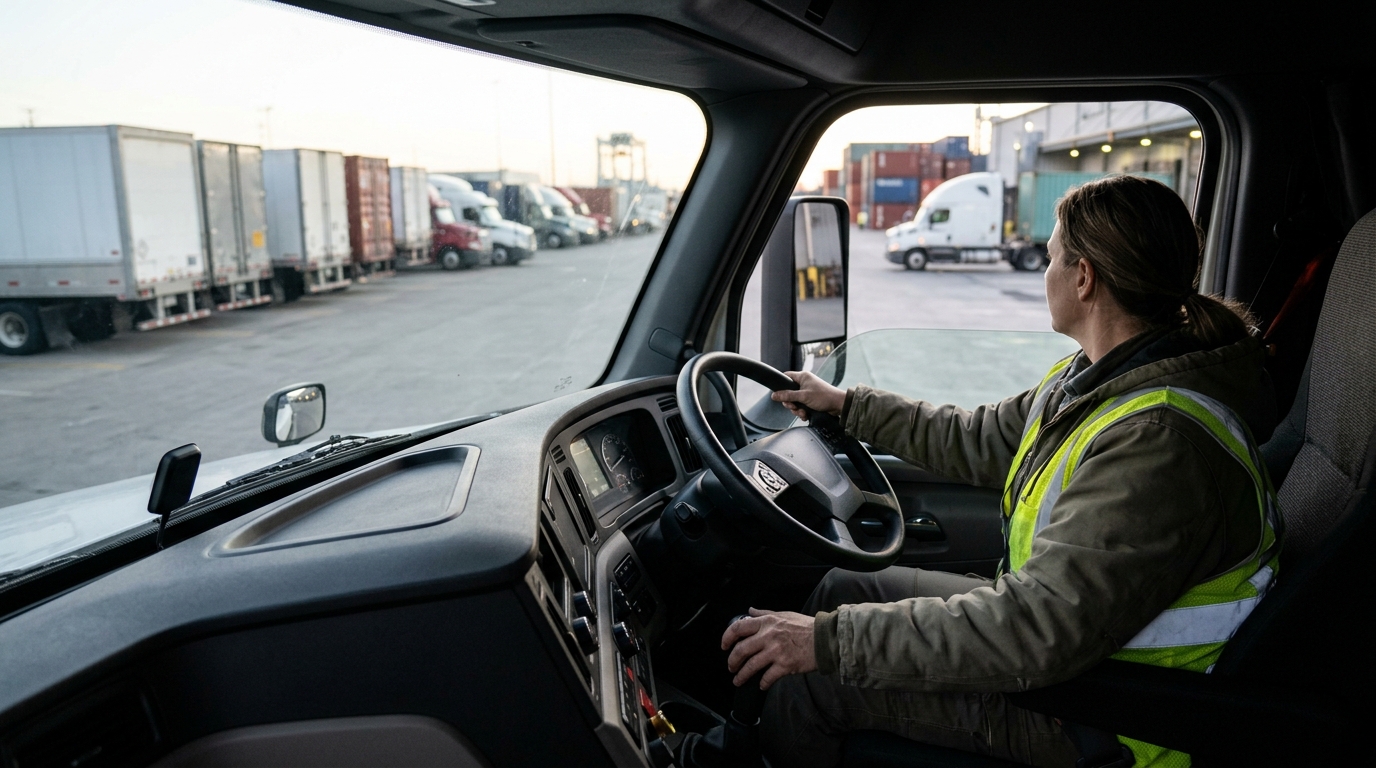
To become a CDL truck driver you need a commercial learner's permit, federally required entry-level driver training from a provider on the FMCSA Training Provider Registry, a DOT medical card, and a passing score on the CDL knowledge and skills tests at your state licensing agency. Most people go from first permit test to licensed and hired within two to six months.
The license is the easy part. The real decisions are what kind of freight you haul, how many nights you spend away from home, and which endorsements you add — those choices shape your pay and your schedule far more than the license itself.
What a CDL Truck Driver does
You move freight legally, safely and on time, and you document every part of it. The driving is only part of the job — inspection, paperwork and waiting fill a surprising amount of the day.
Typical daily tasks:
- Perform a pre-trip inspection: brakes, air lines, lights, tires, coupling, load securement, and the defects log from the previous driver.
- Plan the route around bridge heights, weight limits, truck-restricted roads, fuel stops and parking for your mandatory break.
- Record duty status in the electronic logging device (ELD) and manage hours-of-service limits — driving window, break and the weekly on-duty cap.
- Load, secure or supervise loading: strapping and chaining on flatbed, checking seals and temperature settings on reefer, counting pallets on dry van.
- Handle paperwork: bills of lading, proof of delivery, scale tickets, fuel receipts, and accident or defect reports when something goes wrong.
- Communicate with dispatch or a driver manager about delays, detention time at a shipper, breakdowns and appointment changes.
- Complete a post-trip inspection and report defects so maintenance can fix them before the next dispatch.
Where you work: over-the-road (OTR) long haul, regional runs within a group of states, local or dedicated routes that get you home nightly, LTL freight with multiple stops, and specialized work such as tanker, flatbed, auto hauling, heavy haul or hazmat. Employers range from large carriers and private fleets run by retailers and manufacturers, to small family-owned carriers and owner-operators leased to a motor carrier.
Schedule: there is no standard one. Local and dedicated drivers often work set shifts, including a lot of early morning and overnight starts. OTR drivers typically run multiple days or weeks out, sleep in the truck, and come home on a pattern such as several days off after a few weeks out. Night driving, weekend dispatch and holiday freight are normal in many operations.
The honest downside: you sit for long stretches, eat badly unless you plan, and lose control of your own time at loading docks. Parking at night is often hard to find. A single preventable accident, a failed roadside inspection or a positive drug test can cost you the job and follow you through the FMCSA Drug and Alcohol Clearinghouse and your motor vehicle record for years. Home-time promises made in recruiting do not always survive contact with dispatch, and that is the most common reason new drivers quit.
How to become one
- Confirm you meet the baseline rules before you spend anything. Federal rules generally require you to be 21 to drive across state lines or haul hazardous materials; many states license intrastate drivers at 18. Check your state's driver licensing agency (DMV, BMV or DOR) commercial driver page for the exact age, residency and documentation rules. Time: an afternoon. Cost: none.
- Pull your own driving record and get a DOT physical from a certified medical examiner listed on the FMCSA National Registry. You need a valid medical examiner's certificate (med card) to hold a CDL, and conditions such as uncontrolled blood pressure, diabetes management or sleep apnea may require extra documentation or a waiver process. Time: one to three weeks. Cost: a clinic exam fee, typically under a few hundred dollars and sometimes reimbursed by an employer.
- Study for and pass the commercial learner's permit (CLP) knowledge tests at your state agency, using your state's official CDL manual, which is based on the AAMVA model. Take General Knowledge plus Air Brakes and Combination Vehicles for a Class A. Time: two to six weeks of study. Cost: state permit and test fees, usually modest and set by your state.
- Enroll in entry-level driver training (ELDT) with a provider on the FMCSA Training Provider Registry. Since the ELDT rule took effect, new Class A and Class B applicants and most new endorsement seekers must complete theory and behind-the-wheel training from a registered provider before testing. Options are a private truck driving school, a community college program, or a carrier's own paid school. Time: three to eight weeks full time, longer part time. Cost: ranges widely by state and program length — private schools run into the thousands of dollars, community colleges are often cheaper and may accept financial aid, and company-sponsored training can be near-zero upfront in exchange for a contract term.
- Read any training contract line by line before you sign. Company-sponsored schools commonly require you to stay 8 to 14 months or repay tuition. Ask the recruiter, in writing, what you owe if you leave early, if you are fired, or if you fail the skills test. Time: one evening. Cost: none, and it can save you thousands.
- Pass the CDL skills test: the vehicle inspection, basic control skills (straight line backing, offset back, alley dock) and the on-road drive. Test in a manual transmission truck if you do not want an automatic-only restriction on your license. Time: one to three weeks after training, depending on test appointment backlogs. Cost: state skills test and license issuance fees; retests cost extra.
- Add endorsements that match the work you want. Common ones are H (hazmat, which requires a TSA background check and fingerprinting), N (tank), X (combined tank and hazmat), T (doubles/triples) and P or S (passenger and school bus). Endorsements narrow the applicant pool you compete in. Time: two to eight weeks, mostly waiting on the TSA check for hazmat. Cost: knowledge test fees plus the TSA threat assessment fee for H.
- Register in the FMCSA Drug and Alcohol Clearinghouse and apply to carriers. Employers must query the Clearinghouse before hiring and annually afterward, and you must grant consent. Apply widely to recent-grad-friendly carriers, and ask each recruiter the same three questions: average weekly miles or hours, the exact home-time pattern, and the age and transmission type of the equipment. Time: one to four weeks to an offer. Cost: none.
- Complete finishing training with a trainer — most carriers put new CDL holders with a mentor for one to six weeks before solo dispatch. Treat it as the real job interview and keep a notebook of backing setups, shipper quirks and fuel-stop routines.
Skills you'll need
Hard skills
- Vehicle inspection to CVSA standards. You should be able to walk a tractor-trailer and call out brake adjustment, air leaks, tire defects and securement problems the way a roadside inspector would. Clean inspections protect your record and your carrier's CSA scores.
- Hours-of-service compliance on an ELD. Know the driving window, the 30-minute break rule, the weekly cap and how split sleeper berth works, and be able to fix a log edit or an unassigned drive segment without creating a violation.
- Backing and low-speed maneuvering. Offset backs, alley docks and blindside backing in a crowded dock yard. This is where most new-driver damage claims come from.
- Load securement and weight distribution. Cargo securement rules under FMCSA Part 393 for flatbed, axle weights and sliding the tandems or fifth wheel so you scale legal at a CAT scale.
- Trip planning tools. A truck-specific GPS or routing app plus a current motor carriers' road atlas, fuel-stop planning, and reading a shipper's appointment window against your available hours.
- Basic roadside troubleshooting. Chaining up in winter states, changing a trailer light, dealing with a frozen air line or a dead battery, and knowing when to stop and call maintenance instead.
Soft skills
- Patience under delay. Show it by how you handle a four-hour detention at a shipper: notify dispatch early, document arrival and departure times, and claim detention pay through the proper channel rather than arguing at the dock.
- Clear, short communication. Show it by sending dispatch a status message that includes location, ETA, problem and what you need — not a complaint.
- Self-discipline. Show it by holding a routine on the road: sleep schedule, pre-trip every single day, meals planned, and no attempt to stretch a log to make an appointment.
- Situational awareness and risk judgment. Show it by shutting down for weather and telling dispatch why, which is defensible, rather than pushing through and risking a rollover.
- Customer-facing composure. Show it on LTL and local routes, where you deal with receivers, security guards and the public, and where your conduct is the carrier's reputation.
Pay and outlook
Truck driver pay is structured in several different ways, and comparing offers means comparing structures, not just headline numbers. Common models are cents per mile for OTR and regional work, hourly pay for local and union LTL work, a percentage of the load's revenue for owner-operators and some specialized freight, and salary or day rate for certain dedicated accounts. On top of base pay, carriers add accessorial pay: detention after a set number of hours at a shipper, stop pay, layover, breakdown pay, tarping on flatbed, and per-diem allowances. A good per-mile rate on a lane with poor freight volume can pay less than a lower rate with steady miles, so ask about average weekly miles or hours before you ask about the rate.
What drives pay upward: endorsements, especially hazmat and tanker; specialized freight such as heavy haul, oversize, auto transport or liquid bulk; a clean MVR, clean Clearinghouse record and clean roadside inspections; years of verifiable experience; willingness to stay out longer; and geography, since pay and freight demand vary considerably between metro areas and states. Union contracts at some LTL and private fleets set different rates and progressions than non-union over-the-road work. Owner-operators gross more but carry truck payments, fuel, insurance, maintenance, IFTA taxes and downtime — net is a different number entirely.
What holds pay down: being a recent graduate inside a training contract, automatic-only or intrastate restrictions on your license, accidents or violations in the last three years, and seasonal freight slumps. Freight is cyclical. In a soft market, carriers cut miles before they cut drivers, so your weekly earnings can drop without any change to your pay rate.
For current national and state-level wage and employment data, check the US Bureau of Labor Statistics Occupational Outlook Handbook entry for heavy and tractor-trailer truck drivers, and the BLS Occupational Employment and Wage Statistics pages, which break figures out by state and metro area. Your state workforce agency or labor market information site publishes local demand data. For a specific employer, ask the recruiter for the pay package in writing, including the detention and layover rules, and talk to a current driver at that terminal if you can.
On demand: freight volume tracks the wider economy, and driver turnover at large over-the-road carriers is persistently high, which is why entry-level hiring continues even when the market is soft. Automation gets discussed constantly; the near-term effect most drivers feel is more monitoring technology in the cab — inward-facing cameras, speed limiters, automated coaching alerts — rather than disappearing jobs.
Career path
| Stage | Typical titles | Usual time at this stage |
|---|---|---|
| Entry | CDL student, student driver with a trainer, recent-grad OTR driver | 0–12 months |
| Early | Solo OTR or regional driver, dry van or reefer | 1–2 years |
| Mid | Dedicated route driver, LTL line haul or city P&D driver, flatbed or tanker driver, hazmat driver | 2–5 years |
| Senior | Heavy haul or oversize driver, driver trainer, lead driver, owner-operator, lease-purchase operator | 5+ years |
| Off the truck | Dispatcher, driver manager, safety manager, recruiter, terminal or operations manager, DOT compliance specialist | 5–10+ years, usually after driving experience |
The first year is the gate. Most carriers and most insurers treat two years of verifiable experience as the threshold that opens up better-paying freight, private fleets and dedicated accounts with predictable home time. That is why many drivers take a less appealing first job deliberately and leave once they have clean experience banked.
From there the path forks. One fork is specialization: add endorsements, move to tanker, flatbed or heavy haul, and accept more physical work and more technical skill in exchange for better rates. A second fork is lifestyle: move to local or dedicated work and trade some earning potential for being home nightly. A third is ownership, buying or leasing a truck and running as an owner-operator under your own authority or leased to a carrier — this is a business, with fuel, insurance, maintenance, taxes and cash-flow management, and it is where inexperienced drivers most often lose money.
The fourth fork is off the truck entirely. Dispatch, safety, compliance and recruiting roles value people who have actually run the hours and the loads, and they are the standard route for drivers who want to stop living in a sleeper but stay in the industry. Keep records as you go: your inspection reports, your employment history with dates and carriers, and your Clearinghouse status — hiring managers will ask for all three.
Frequently asked questions
Do I need a degree to become a CDL truck driver?
No. There is no degree requirement. What you need is a commercial learner's permit, entry-level driver training from a provider on the FMCSA Training Provider Registry, a DOT medical certificate and a passing CDL skills test. Most employers also want a high school diploma or GED, a verifiable work history and a driving record they can insure. If you want to move into safety, compliance or operations management later, some employers prefer a degree for those roles, but it is not a barrier to getting behind the wheel.
How long does it take to get hired as a new driver?
Typically two to six months from the day you start studying for the permit. Roughly: a few weeks of study and the CLP tests, three to eight weeks of full-time training, one to three weeks waiting on a skills test appointment, then one to four weeks of applications and onboarding, plus one to six weeks with a trainer before you go solo. The spread depends on your state's test backlog, whether you train full or part time, how quickly you clear the DOT physical, and whether you are adding a hazmat endorsement that needs a TSA background check.
Can any of this work be done remotely?
The driving cannot. The truck has to be where the freight is, and that is the whole job. Some adjacent roles in the industry are partly or fully remote — dispatch, driver recruiting, DOT compliance and freight brokerage are all done by phone and laptop at some companies — and experienced drivers often move into them. If remote work is your actual goal, look at those roles directly rather than getting a CDL first.
Is company-sponsored CDL training worth it?
It depends on the contract, not the training. A carrier school removes most of the upfront cost, which matters a lot if you cannot fund a private school. In exchange you commit to staying a set period — commonly around a year — or repaying tuition. Read the repayment terms before signing, and ask specifically what you owe if you are fired, if you fail the skills test, or if you leave for medical reasons. If you can fund your own training, you keep the freedom to leave a bad carrier immediately, which is worth something.
What disqualifies someone from getting or keeping a CDL?
The common blockers are medical: uncontrolled blood pressure, certain vision or hearing limits, untreated sleep apnea and some medications can delay or prevent certification until documented or treated. On the record side, recent DUIs, serious traffic violations, a refused or failed drug or alcohol test recorded in the FMCSA Drug and Alcohol Clearinghouse, or a suspended license will stop most hiring and can bar licensing. Rules differ by state and by employer policy — check your state driver licensing agency's commercial driver page and talk to a certified medical examiner from the National Registry before you pay tuition.