 The
How Long Does It Take to Become a Welder?
Entry-level training can run a few months, a two-year degree takes longer, and a code test sits at the end of both — here is how the timing breaks down.
By Theo Lindqvist · Published · Updated · 13 min read
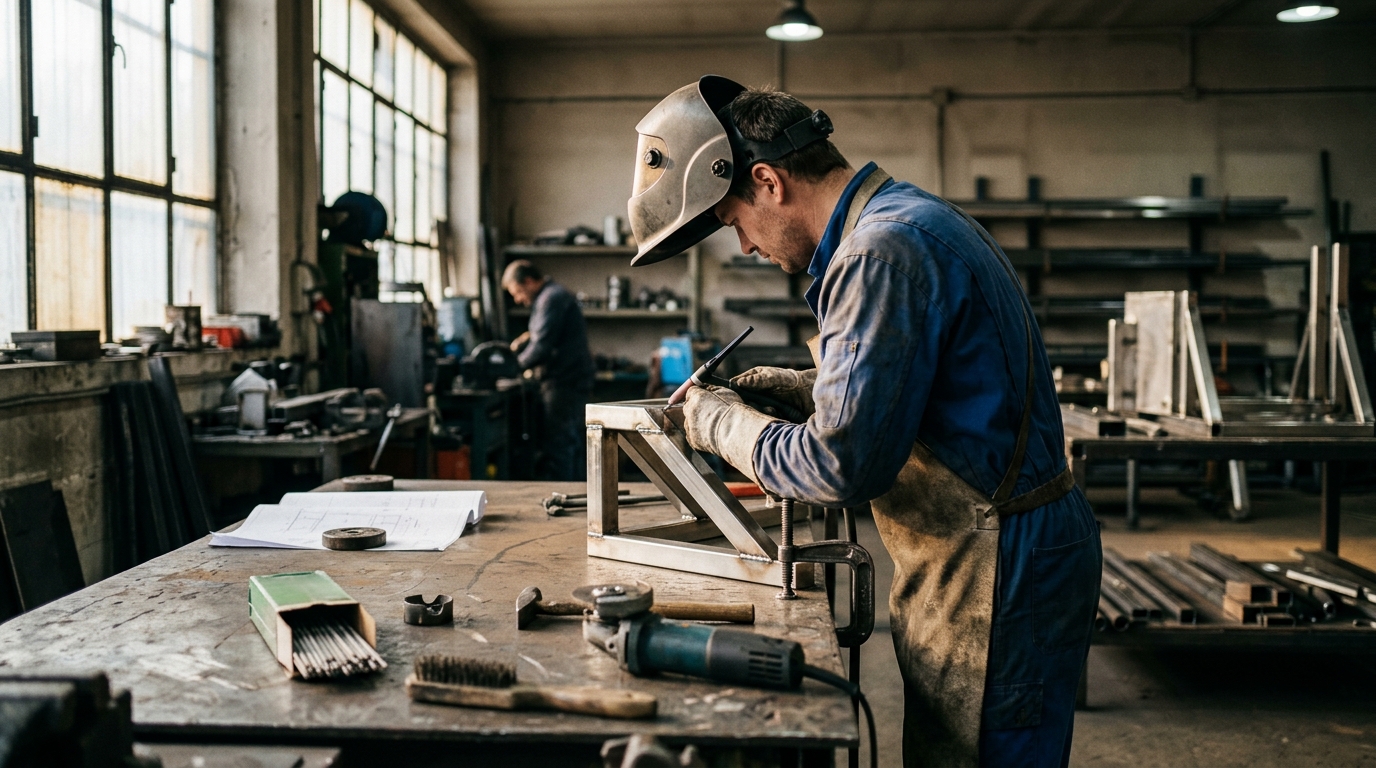
Most people reach their first paid welding job in six to twelve months. A short certificate program at a community college or trade school usually runs four to nine months, an associate degree runs about two years, and some production shops will hire with only a few weeks of training and put you on one joint until you are fast at it.
The longer timeline is not the classroom — it is the hours of arc time and the code test at the end. Passing a performance qualification on plate can take a few months of practice; passing one on pipe, in position, usually takes longer.
What a welder does
Welding is joining metal with heat, then proving the joint is sound. Most of a shift is preparation and cleanup; the arc itself is a smaller share of the day than people expect.
A typical day includes:
- Reading the drawing and the welding procedure specification (WPS) to confirm the process, filler metal, amperage range, preheat and the number of passes a joint needs.
- Cutting, beveling and fitting parts with a grinder, bandsaw, oxy-fuel torch or plasma cutter, then tacking them square with clamps, magnets and a framing square.
- Setting up the machine — polarity, wire speed, gas flow, electrode size — and running a test bead on scrap before touching the part.
- Welding out the joint in whatever position the work sits in: flat, horizontal, vertical, overhead, or all four on one pipe.
- Cleaning between passes, chipping slag, wire-brushing, grinding starts and stops, and visually inspecting for undercut, porosity and lack of fusion.
- Repairing rejected welds after an inspector marks them, which means gouging or grinding the bad metal out and running it again.
- Keeping the area safe: fire watch, ventilation or a fume extractor, screens so nobody catches arc flash, and gas bottles chained upright.
Where you work varies more than the trade itself. Fabrication and manufacturing shops are indoors, climate-controlled at best and loud at least. Construction and structural work puts you outside, on lifts, in trenches, or on a beam in whatever weather the site has. Shipyards, pipelines, refineries, power plants and food or pharmaceutical plants each have their own rules, materials and cleanliness standards. Maintenance welders in a plant spend as much time diagnosing a broken part as welding it.
Schedules depend on the sector. Shop work is often a fixed day shift, forty hours, with overtime when a job is behind. Manufacturing runs second and third shifts, sometimes four tens or twelve-hour rotations. Industrial shutdowns and turnarounds are short bursts of six or seven twelve-hour days for a few weeks, then nothing. Pipeline and travel work means living away from home for the length of the job.
The honest downside: it is hot, loud and dirty, you breathe fumes that require real ventilation discipline, and the work is hard on knees, shoulders and eyes. Burns are routine, not dramatic. Work can be seasonal or project-based, so layoffs between jobs are normal in construction and in travel work, and your first few months will include welds that get rejected in front of other people.
How to become one
- Spend a day watching the work before you spend money. Call a local fabrication shop or the welding instructor at a community college and ask to sit in on a lab or walk the shop floor. Cost: nothing. Time: one or two weeks to arrange. Ask the instructor which processes local employers hire for — a shop town and a pipeline town want different skills.
- Buy the safety gear you will use from day one. An auto-darkening helmet, flame-resistant jacket, leather gloves for stick and MIG plus a thinner pair for TIG, safety glasses, steel-toe boots and earplugs. Expect a range from a basic starter set to several times that for a high-end helmet and a leather jacket; most schools publish a required gear list and some include it in tuition. Time: one day of shopping.
- Enroll in a welding program at a community college or trade school. A certificate or diploma typically runs four to nine months full time; an associate of applied science runs about two years and adds blueprint reading, metallurgy and inspection coursework. Tuition varies widely by state, by in-district versus out-of-district residency, and by whether consumables and gear are included — ask the program for its published cost of attendance and whether federal aid or a state workforce grant applies. Named example: an AWS SENSE-aligned entry-level welder program.
- Log arc time on one process until it is boring, then add the next. Most programs start with SMAW (stick) on 6010 and 7018 electrodes, then FCAW, GMAW and GTAW. Plan on several hundred hours of practice across six to eighteen months to get comfortable in all positions. If you have a machine at home, build something real — a welding table, a cart, a trailer tongue repair — because fitting your own project teaches more than running beads on scrap.
- Get an OSHA 10-hour construction card. One day online or in person, low cost, and many job sites will not badge you without it. Add a confined space or hot work permit class if your target industry is refineries or shipyards.
- Pass a performance qualification test to a code. The common first one is a 3G or 4G plate test to AWS D1.1 structural code; pipe work moves to ASME Section IX or API 1104. Test fees vary by facility and include your coupon material and bend or radiographic testing; book it through an AWS Accredited Test Facility or take the employer's own in-house test. Time: a few weeks of focused practice once you can run the position consistently. Expect that some people fail the first attempt and retest.
- Build a one-page record of what you can weld. List process, position, material, thickness and code for each qualification, and keep photos of your coupons, a cut-and-etch macro and any finished project. Named example: a dated copy of your welder performance qualification record (WPQR) — employers ask for it, and continuity lapses if you go too long without welding under that procedure.
- Apply where the welding is, and ask to test. Hand the resume to the shop's welding supervisor or foreman rather than only uploading it. Apply to a registered apprenticeship through a local building-trades joint apprenticeship committee if you want paid on-the-job training; those run roughly three to five years to journey level. Staffing agencies that specialize in skilled trades will often place you faster but into shorter contracts.
Skills you'll need
Hard skills
- SMAW (stick). Running 6010 root passes and 7018 fill and cap, in all four positions, with control of arc length and travel speed. This is still the test most structural employers give.
- GMAW and FCAW. Short-circuit and spray transfer with solid wire, plus dual-shield flux-cored on heavier plate. Includes setting wire feed speed, voltage, stick-out and shielding gas flow, and recognizing when a bad bead is a setting problem rather than a technique problem.
- GTAW (TIG). Two-handed work with a filler rod on stainless, thin-wall tube and aluminum, including tungsten grinding, purge gas on stainless pipe, and amperage control with a foot pedal.
- Cutting and preparation. Oxy-fuel torch, plasma cutter, angle grinder with cut-off, flap and grinding wheels, and air arc gouging for backgouging and removing rejected welds.
- Blueprint and symbol reading. Interpreting weld symbols, fillet sizes, joint details and a WPS well enough to weld to the procedure without being told each step.
- Measurement and layout. Tape, square, level, protractor, fillet weld gauges and wrap-arounds for pipe — fit-up quality decides how the finished weld looks and whether it passes.
Soft skills
- Attention to detail. Show it by passing a bend test on the first attempt and by catching your own undercut before an inspector does. In an interview, describe a joint you ground out and redid because it was not right.
- Reliability. Show it by turning up before shift start with gear ready. Shop foremen hire for this more than people admit; a tenured attendance record on your resume is a genuine selling point.
- Communication. Show it by asking the fitter or the inspector a clarifying question about a drawing instead of guessing, and by explaining a repair plan in plain language.
- Safety discipline. Show it with an OSHA card and by describing the ventilation, fire watch and PPE routine you follow — including galvanized and stainless fume precautions.
- Patience under physical strain. Overhead work in a hot jacket is a mental task as much as a physical one. Show it by talking about the longest continuous job you have done and how you paced it.
Pay and outlook
Welding pay is almost always hourly, and the hourly rate is only part of what you take home. Overtime after forty hours, shift differential for nights and weekends, per diem on travel jobs, and turnaround premiums during plant shutdowns can change annual earnings more than the base rate does. Union work is usually paid to a negotiated scale with a benefits package on top; non-union shops set rates individually and often add a bump when you pass an in-house test.
Five things drive what a welder is offered:
- Process and position. All-position pipe welding and precision TIG on stainless or aluminum generally pay above flat-position production MIG.
- Certifications. Holding current qualifications to the code an employer works to — AWS D1.1, ASME Section IX, API 1104 — removes risk for them and strengthens your position.
- Industry. Shipbuilding, refinery and pipeline work, power generation and aerospace pay differently from general fabrication and sheet metal.
- Location. Rates vary a great deal between states and between metro and rural areas, partly because of cost of living and partly because of which industries are nearby.
- Travel and schedule. Jobs that take you away from home for weeks usually pay more and come with per diem, but they are project-based and end.
For demand, the forces to watch are construction activity, energy and pipeline investment, shipbuilding contracts, manufacturing and infrastructure spending, and the age profile of the existing workforce — a large share of experienced welders are near retirement, which is a steady source of openings. Automation has taken over much high-volume repetitive welding, so the jobs that stay are the ones needing judgment: field work, repair, one-off fabrication, code work and anything that cannot be fixtured.
Check current figures yourself rather than trusting a number in an article. The U.S. Bureau of Labor Statistics Occupational Outlook Handbook entry for welders, cutters, solderers and brazers gives national pay and projected employment change, and the BLS Occupational Employment and Wage Statistics tables break pay down by state and metro area. Your state workforce agency publishes local wage and demand data. For union work, call the local hall and ask for the current wage package. For a specific employer, ask at interview how the test rate, the post-qualification rate and overtime are structured.
Career path
Timelines below assume full-time work; part-time or seasonal work stretches each stage.
| Stage | Typical titles | Years |
|---|---|---|
| Entry | Welder helper, fitter's helper, production welder, welder trainee, apprentice | 0–2 |
| Mid | Certified welder, structural welder, combo welder/fitter, maintenance welder, pipe welder | 2–7 |
| Senior | Lead welder, welding foreman, shop supervisor, certified welding inspector, welding instructor, weld technician | 7+ |
Entry (0–2 years). You start as a helper, a production welder on repetitive joints, or an apprentice. The work is grinding, fit-up, cleanup and one or two welds done over and over. The goal is speed with consistency and your first code qualification. A registered apprenticeship typically takes three to five years to reach journey level but pays while you learn.
Mid (2–7 years). You hold current qualifications, can fit your own work from a print, and move between processes. This is where the split happens: structural and fabrication work, pipe and process piping, or precision TIG on thin-wall and exotic materials. Combo welders who can both fit and weld pipe are in a different bracket from plate welders. Many people add certifications here — a second code, a different material group, or a specialty like orbital or aluminum.
Senior (7+ years). Three directions open up. Supervision — lead hand, foreman, shop superintendent — trades arc time for scheduling, manpower and quality responsibility. Inspection and quality — the AWS Certified Welding Inspector credential requires documented experience and an exam, and leads into QA/QC roles, welding procedure development and nondestructive testing. Teaching and self-employment — community college instructor, in-house trainer, or your own mobile welding or fabrication business, which adds insurance, bidding and equipment finance to the job description.
Sideways moves are common and worth planning for, because the physical work is demanding over a long career. Welding engineering technician, robotic welding programmer, sales for a welding supply distributor, and plant maintenance planning all build on the same base.
Frequently asked questions
Do I need a degree to be a welder?
No. There is no degree requirement for most welding jobs. What employers check is whether you can pass their test and whether you hold a current performance qualification to the code they work to. A high school diploma or GED is commonly asked for, and an associate degree in welding technology helps if you want to move into inspection, supervision or welding engineering technology later. A certificate program plus a passed code test gets you onto a shop floor faster than a degree does.
How long does it take, realistically?
Four to nine months of full-time training is the common path to an entry job, and six to twelve months is a realistic window from starting out to earning your first paycheck as a welder. A production shop may hire you sooner with minimal training if they need one joint welded repeatedly. Passing a pipe test to ASME Section IX or API 1104 usually takes one to three years of practice and work. A registered apprenticeship runs roughly three to five years to journey level but you are paid throughout.
Can welders work remotely?
No — the work is hands-on and happens where the metal is. The nearest equivalents are travel work, where you go to a job site for weeks or months with per diem, and mobile welding, where you own a rig truck and drive to customers. Some adjacent roles have an office or hybrid component: welding inspection involves a mix of site visits and documentation, and welding procedure writing, estimating and robotic programming can be partly desk-based, but each requires shop experience first.
Is welding certification required by law?
It depends on the work and the jurisdiction. Certification is not a license to weld in general; it is proof you can weld to a specific procedure, and codes such as AWS D1.1 for structural steel or ASME Section IX for pressure work require welders on those jobs to be qualified. Some cities and states add their own requirements for structural work on permitted buildings. Ask the employer and your local building department which qualifications a given job needs, and keep your qualification continuity current.
Can I learn to weld at home instead of going to a school?
You can learn the basics at home with a small machine, a fume extraction plan and a project to build, and many good welders started that way. What home practice does not give you is a structured path to a code test, a supervised booth with the material and positions a test uses, and an instructor who can tell you why your root pass keeps failing. A practical hybrid is to practice at home and enroll in a short program or a testing facility's prep course when you are ready to qualify.

Written by
Theo Lindqvist
Theo tracks hiring trends, wage shifts, and the quiet negotiations happening inside job postings. He reads want ads the way other people read tea leaves.