 The
How to Become a Welder (Steps, Skills and Pay)
A practical look at the work itself, the training routes, the certifications that matter, and the shift patterns most welders actually end up working.
By Marisol Andrade · Published · Updated · 15 min read
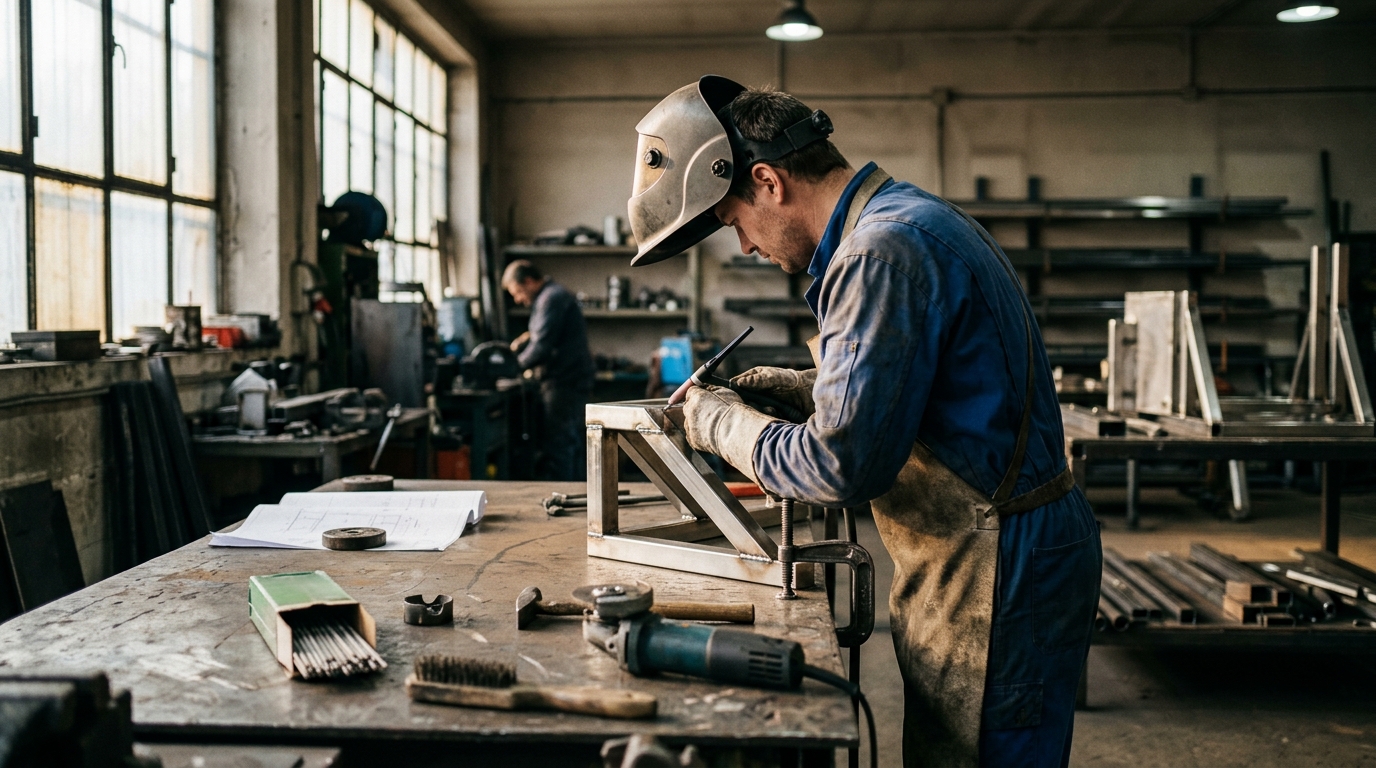
To become a welder, you typically finish high school or an equivalency, take technical training at a vocational-technical institute, community college, private welding school, high school program or through the U.S. Armed Forces, then learn the rest on the job — the U.S. Bureau of Labor Statistics (2026-08-27) describes that combination as the usual entry route, and many workers come in through an employer-based apprenticeship instead. Some apprenticeships take entry-level workers with no prior experience; others want a completed vocational-technical welding program first (U.S. Bureau of Labor Statistics, 2026-08-27).
The work is hands-on, physical and shift-based, and your value rises with the processes, positions and materials you can prove you weld to code. This guide covers the daily tasks, the steps in order, the skills, how pay is structured, and where the job leads.
What a welder does (list)
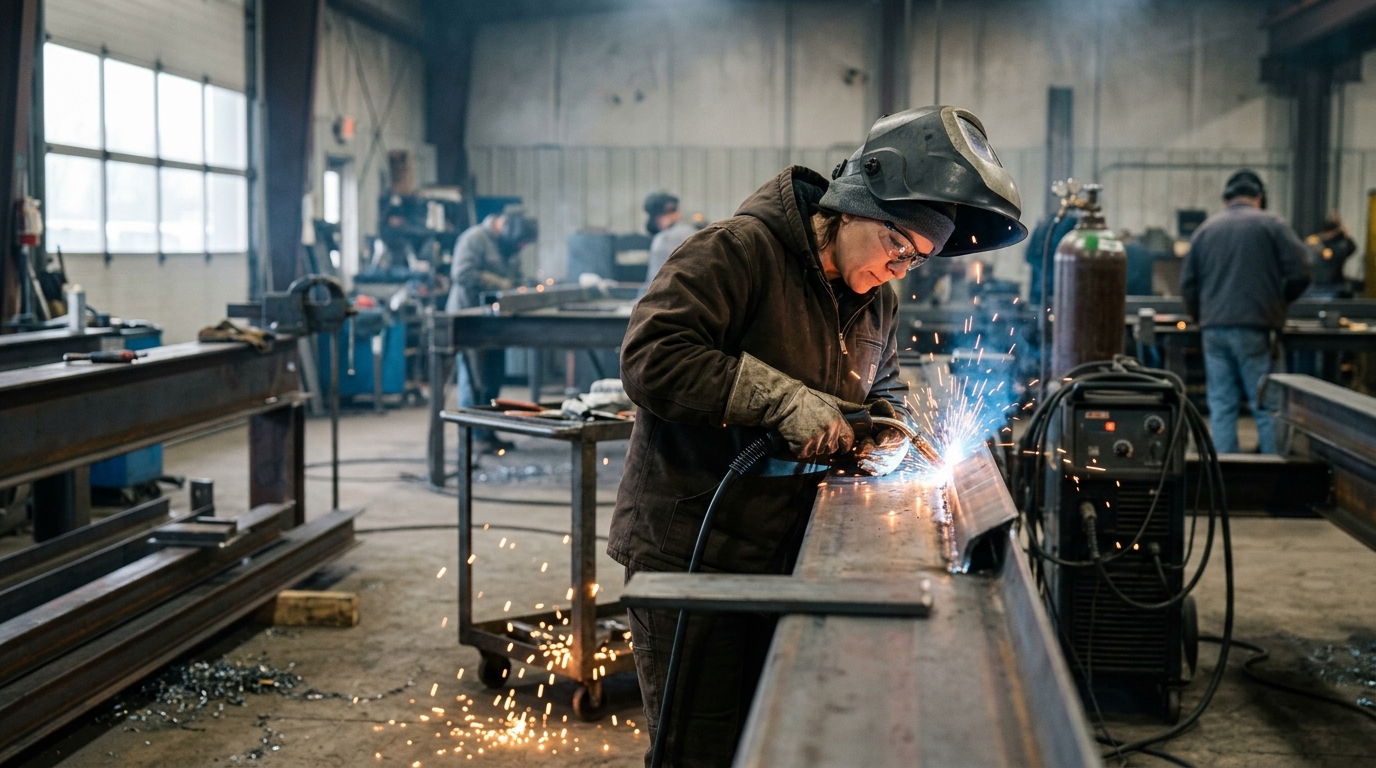
Welders, cutters, solderers and brazers use hand-held or remotely controlled equipment to join, repair or cut metal parts and products (U.S. Bureau of Labor Statistics, 2026-08-27). The day is less about continuous arc time than most people expect — a lot of it is layout, fit-up, grinding and checking your own work.
Typical daily tasks:
- Read and interpret blueprints, sketches and written specifications before striking an arc (U.S. Bureau of Labor Statistics, 2026-08-27).
- Calculate and measure the dimensions of the parts to be welded, then mark and cut material to those dimensions.
- Inspect the structures or materials to be welded — checking for cracks, contamination, mill scale, fit-up gaps and joint prep.
- Weld to blueprint specification, holding the required bead profile, travel speed and sequence.
- Monitor the welding process and adjust heat, amperage, wire feed or gas flow as necessary to avoid burn-through, porosity and distortion.
- Maintain equipment and machinery — change contact tips and liners, check gas bottles and regulators, replace grinder discs, keep leads and clamps in safe condition.
- Clean up: slag removal, grinding, wire-brushing, marking parts and staging them for inspection.
Where you work varies more than the job title suggests. Common settings are manufacturing plants and fabrication shops, construction sites, shipyards, pipelines, mines, repair garages and maintenance departments inside larger facilities. The BLS lists the largest employing industries by share of employment on its Occupational Outlook Handbook page, which is worth reading before you choose a training path — a shop welder's day and a field welder's day are not the same job.
Schedule: most welders, cutters, solderers and brazers work full time, some work more than 40 hours a week, and many manufacturing firms run two or three 8- to 12-hour shifts a day, so evening and weekend work is common (U.S. Bureau of Labor Statistics, 2026-08-27). Field and shutdown work can mean long stretches away from home, then gaps between contracts.
The honest downside: it is hot, loud and dirty, you will get burns, and overhead and out-of-position welding punishes your shoulders, neck and knees. Fumes, UV flash and noise are managed with ventilation and PPE, not eliminated. Shop work can be repetitive — the same joint, hundreds of times. Work in construction-linked sectors rises and falls with capital spending, so layoffs between projects are normal rather than a sign you did something wrong.
How to become one (steps)
- Finish high school or an equivalency, and take every shop and math class offered. Entry typically requires a high school diploma or equivalent combined with technical and on-the-job training, and high school technical education classes are one of the recognised training routes (U.S. Bureau of Labor Statistics, 2026-08-27). Time: whatever remains of your schooling. If you are past school age, a GED or state equivalency usually takes a few months of study; test fees are set by each state, so check your state's education department page for the current charge.
- Tour two or three training providers and ask whether the program follows AWS SENSE. SENSE — Schools Excelling through National Skill Standards Education — is a set of minimum standards and guidelines for welding education programs, and schools that incorporate it can help attain Perkins funding (American Welding Society, undated). Time: a week or two of visits. Cost: none to visit. Ask to see the booth-to-student ratio and how many hours of actual arc time you get per week.
- Enroll in a welding program or apply to an employer-based apprenticeship. Training is available through vocational-technical institutes, community colleges, private welding schools or the U.S. Armed Forces, and some apprenticeships accept entry-level workers with no prior experience while others target graduates of a vocational-technical program (U.S. Bureau of Labor Statistics, 2026-08-27). O*NET OnLine (2026) lists registered apprenticeship titles for the occupation that are vetted by industry and approved by the U.S. Department of Labor — search your state's apprenticeship office for openings. Time: a few months for a focused certificate up to about two years for an associate degree; apprenticeships run longer because you earn while you learn. Cost: tuition varies enormously by state, school type and length — get the all-in figure in writing from the school, including consumables, books and PPE, and ask which programs are approved for state or federal workforce funding.
- Buy your own hood, gloves and hand tools early and use them in class. A quality auto-darkening helmet, leathers, a chipping hammer, a wire brush, soapstone, a tape measure, fitting squares and a 4.5-inch angle grinder cover most first-year needs. Time: one shopping trip. Cost: set by the supplier — price a complete list at a local welding supply store rather than guessing, and ask the instructor which items the school supplies.
- Complete the safety training your employer and the law require, including OSHA electrical safety training. OSHA requires welders to complete training on electrical safety (U.S. Bureau of Labor Statistics, 2026-08-27). Many shops add hot work permits, confined space, fall protection and respirator fit testing. Time: hours to a few days, usually paid or built into the program.
- Pass a hands-on performance qualification test on the process and position your target employer uses. The AWS Certified Welder credential is the entry-level test of this kind, and performance tests are usually taken at an accredited test facility or at the employer's own facility. Time: a day for the test, plus weeks of practice beforehand. Cost: a test fee set by the facility plus material — ask the test site for its current fee schedule. Practice until you can pass a bend test on scrap before you pay for the real thing.
- Check whether your state or locality licenses welders. Welders must be licensed in some states and localities and requirements vary (U.S. Bureau of Labor Statistics, 2026-08-27). Time: an afternoon. Call your city building department or state licensing board and ask directly what is required for structural welding where you intend to work.
- Build a short portfolio of coupons and projects, then talk to shop foremen in person. Keep sectioned and etched coupons showing penetration, a fabricated project such as a welded steel workbench or a trailer repair, and photos with the drawings you worked from. Time: ongoing. Cost: scrap and gas. Foremen hire on what you can do in their booth on test day, so ask for a weld test, not an interview.
Skills you'll need (list)
Hard skills
- Arc processes. Stick (SMAW) for field and repair work, MIG (GMAW) for production shops, flux-cored (FCAW) for heavy structural and outdoor work, and TIG (GTAW) for thin material, stainless and aluminium. Most welders start strong in one and add the others; the more processes you can pass a test on, the more jobs you qualify for.
- Cutting and shaping. Oxy-fuel torch, plasma cutter, band saw, chop saw and the 4.5-inch angle grinder with cutting, grinding and flap discs. Joint prep and bevelling decide whether the weld has a chance.
- Blueprint and weld symbol reading. Reading and interpreting blueprints, sketches and specifications is a core daily duty (U.S. Bureau of Labor Statistics, 2026-08-27). You need to decode fillet sizes, groove types, field weld flags and NDT call-outs without asking.
- Measurement and layout. Tape measure, combination square, framing square, levels, bevel protractor, fillet weld gauges and a high-low gauge for pipe fit-up. Calculating and measuring dimensions is listed among the typical duties (U.S. Bureau of Labor Statistics, 2026-08-27).
- Machine setup and troubleshooting. Setting amperage, voltage, wire feed speed, gas flow and polarity, and recognising from the bead what to change. Also basic maintenance: liners, drive rolls, contact tips, tungsten grinding, regulator checks.
- Visual inspection of your own work. Spotting undercut, porosity, cold lap, excessive reinforcement and distortion before an inspector does.
Soft and physical qualities — the BLS (2026-08-27) names detail orientation, manual dexterity, physical stamina, physical strength and spatial-orientation skills as important for this occupation. Show them like this:
- Detail orientation: bring coupons cut and etched so a foreman can see penetration, and point out where you corrected a fit-up problem rather than welding over it.
- Manual dexterity: ask for a weld test in the position the job actually requires — overhead or 6G if that is the work — instead of demonstrating in flat position.
- Physical stamina and strength: describe the longest shift pattern you have worked, including 10- or 12-hour shifts, and how you handled the lifting and standing.
- Spatial orientation: talk through a drawing with the foreman, explaining the weld sequence you would use to control distortion.
- Reliability and safety discipline: show your completed safety training, including OSHA electrical safety, and give an example of stopping work over a hot-work or ventilation issue.
Pay and outlook (prose)
Pay for welders is almost always structured as an hourly wage, with overtime past 40 hours in most jobs, and often with add-ons that matter more than the base rate. Common add-ons include shift differentials for nights and weekends, per diem and travel pay for field and shutdown work, hazard or height pay, and tool or truck allowances for rig welders who bring their own equipment. Apprentices are normally paid on a progression schedule that rises as they complete hours and pass milestones. Union shops pay to a negotiated scale; non-union shops set their own rates and may add production or quality bonuses.
What drives the number up: the processes and positions you are qualified on — TIG and pipe work in 6G usually pay above flat-position production MIG; the industry, since pressure, pipeline, shipbuilding, aerospace and nuclear work typically demand more documentation and pay accordingly; whether the role requires travel or long rotations away from home; whether a state or locality licenses welders, since licensing requirements vary by place (U.S. Bureau of Labor Statistics, 2026-08-27); and plain geography, because a shop in a high-cost metro and one in a rural county do not pay alike. Credentials matter at the margins: the American Welding Society (undated) offers a family of credentials beyond the entry-level Certified Welder, including Certified Welding Inspector (CWI), Senior Certified Welding Inspector (SCWI), Certified Welding Supervisor (CWS), Certified Welding Educator (CWE), Certified Welding Engineer (CWENG) and Certified Resistance Welding Technician (CRWT).
On demand: the BLS projects employment of welders, cutters, solderers and brazers to grow more slowly than average from 2025 to 2035 (U.S. Bureau of Labor Statistics, 2026-08-27). Openings are nonetheless projected each year on average over the decade, mostly from workers transferring to other occupations or leaving the labor force rather than from new positions being created (U.S. Bureau of Labor Statistics, 2026-08-27). Practically, that means replacement hiring is the main door in, automation keeps pressure on repetitive production welding, and the welders least exposed are the ones who can do the work robots struggle with: field repair, odd geometry, pipe, and anything requiring judgement about fit-up.
For current wage figures, employment levels and the projection detail, go to the U.S. Bureau of Labor Statistics Occupational Outlook Handbook page for welders, cutters, solderers and brazers, and to the BLS Occupational Employment and Wage Statistics pages for state and metropolitan-area breakdowns. Those pages are updated on a schedule and are the right reference to quote in a pay conversation; figures circulated on training-provider websites are often older or national when what matters is your state.
Career path (timeline)
ONET OnLine (2026) places this occupation in Job Zone 1-2 — very little to some preparation needed, with job training ranging from a few days to one year on the job — so the first rung comes quickly, and the climb afterwards is about qualifications and accountability rather than years alone. ONET also publishes a sample of reported job titles for the occupation, which is useful when you are scanning listings that use different words for the same work.
| Stage | Typical titles | Usual time at this stage |
|---|---|---|
| Entry | Welder's helper, fitter's helper, production welder, apprentice welder, MIG welder | 0-2 years |
| Mid | Combination welder, structural welder, pipe welder, welder-fabricator, maintenance welder | 2-6 years |
| Senior | Lead welder, weld foreman, shop supervisor, quality or weld inspector, welding instructor | 6+ years |
Entry (0-2 years). You grind, fit, tack and run repetitive production welds, often on one process in one or two positions. Work experience in a related occupation is commonly expected for entry, and on-the-job training is how competency is reached (U.S. Bureau of Labor Statistics, 2026-08-27) — so helper and fabrication-shop roles count toward the next step even when the arc time is limited.
Mid (2-6 years). You add processes and positions, pass performance tests on the ones your sector uses, and start working directly from drawings with less supervision. This is the stage where specialising pays: pipe, stainless and aluminium, aerospace or heavy structural all open different doors. Many welders also pick up fitting skills here, which is what turns a welder into a fabricator.
Senior (6+ years). Routes split. One is supervision — lead hand, foreman, shop supervisor — where the Certified Welding Supervisor credential is relevant (American Welding Society, undated). One is inspection: AWS Certified Welding Inspector eligibility accepts several education and experience combinations, including a high school diploma or approved equivalency diploma with a minimum of five years of welding-based work experience, or an associate or higher degree in welding or a related engineering technology with a minimum of two years of welding-based work experience (American Welding Society, undated). A third is teaching, via the Certified Welding Educator credential, and a fourth is running your own mobile or job shop, which adds business, insurance and licensing obligations that vary by state and locality.
Moving off the floor is the common goal, because the physical demands of out-of-position welding do not get easier with age. Plan the inspector or supervisor route several years before your body makes the decision for you.
Frequently asked questions
Do I need a college degree to become a welder?
No. Entry typically requires a high school diploma or equivalent combined with technical and on-the-job training, delivered through high school technical education classes, vocational-technical institutes, community colleges, private welding schools or the U.S. Armed Forces (U.S. Bureau of Labor Statistics, 2026-08-27). An associate degree is optional, but it shortens the experience requirement for some later credentials — AWS Certified Welding Inspector eligibility accepts an associate or higher degree in welding or a related engineering technology with a minimum of two years of welding-based work experience, versus five years with a high school diploma or approved equivalency (American Welding Society, undated). What employers actually test is whether you can pass a weld test on their process, position and material.
How long does it take to get a first welding job?
Faster than most trades. O*NET OnLine (2026) puts the occupation in Job Zone 1-2, with job training ranging from a few days to one year on the job, so some shops will hire a helper or production welder with minimal prior training and teach the rest. A focused certificate program usually runs a few months to around a year depending on the school and state, and an associate degree around two years. An employer-based apprenticeship gets you working from the start — some accept entry-level workers with no prior experience, others want a completed vocational-technical welding program first (U.S. Bureau of Labor Statistics, 2026-08-27). The spread depends on your local labour market, which processes you can already run, and whether you can pass a test in the position the job requires.
Can welding be done remotely?
The welding itself cannot. It is hands-on work with hand-held or remotely controlled equipment to join, repair or cut metal (U.S. Bureau of Labor Statistics, 2026-08-27), and you need to be at the part. The nearest things to remote work are robotic welding cell programming and operation, which still happens on the shop floor, and some inspection, estimating, welding engineering and training roles that involve office or hybrid time later in a career. If location flexibility matters to you, the realistic version in this trade is travel work — field, shutdown and pipeline jobs that move you between sites — not working from home.
Do I need a licence or certification to weld?
It depends where you are and what you weld. Welders must be licensed in some states and localities, and requirements vary (U.S. Bureau of Labor Statistics, 2026-08-27), so call your state licensing board or city building department before assuming. Separately, OSHA requires welders to complete training on electrical safety (U.S. Bureau of Labor Statistics, 2026-08-27). Beyond that, professional organisations offer courses leading to general certification, and most code work requires a performance qualification test on the specific process, position and material — which is usually employer- or procedure-specific rather than a one-time licence you keep forever.
Is it worth choosing a school that uses AWS SENSE?
It is a useful filter. SENSE is a set of minimum standards and guidelines for welding education programs, and schools that incorporate it can help attain Perkins funding (American Welding Society, undated), which tells you the program has been built against an industry benchmark rather than assembled ad hoc. It is not the only sign of a good school. Also compare arc hours per week, booth-to-student ratio, which processes and positions you will actually test on, what the program includes in its published cost, and where recent graduates were hired locally — ask for names of shops and then ask those shops what they think of the program.
Sources
- U.S. Bureau of Labor Statistics — Welders, Cutters, Solderers, and Brazers : Occupational Outlook Handbook (2026-08-27)
- O*NET OnLine — 51-4121.00 - Welders, Cutters, Solderers, and Brazers (2026)

Written by
Marisol Andrade
Marisol steers Jobguidedaily's coverage of career pivots and the messy middle of working life. She's drawn to the moment someone realizes their job title no longer fits who they are, and what they do next.